

I seem to be on a roll with these ancient places recently discovered or at least uncovered. I saw an instagram post recently about someone in Turkey who opened a wall to discover an ancient underground city! Elengubu was a multi-level, underground refuge near the town of Derinkuyu in Cappadocia, Turkey. It's one of the largest and best-preserved examples in the world. The first of these might have been built by Phrygians in the 8th-7th century BCE. Greek and Phrygian inscriptions can be found on walls.

I thought this was a possibility only conceived in films such as The Matrix II. Imagine finding such a network on the other side of a wall in your home? It reminds me of dreams I've had.
As recently as 1923, people took religious refuge in these tunnels. In 1963, they were rediscovered after a resident of the area found a mysterious room behind a wall in his home while renovating. Carved into soft volcanic rock, this underground city was designed to accommodate a large population, potentially up to 20,000 people.
I created a multi-level subterranean refuge in the elven forest in my Lost Xentu series, on a planet called Terlond, little knowing they exist on earth.
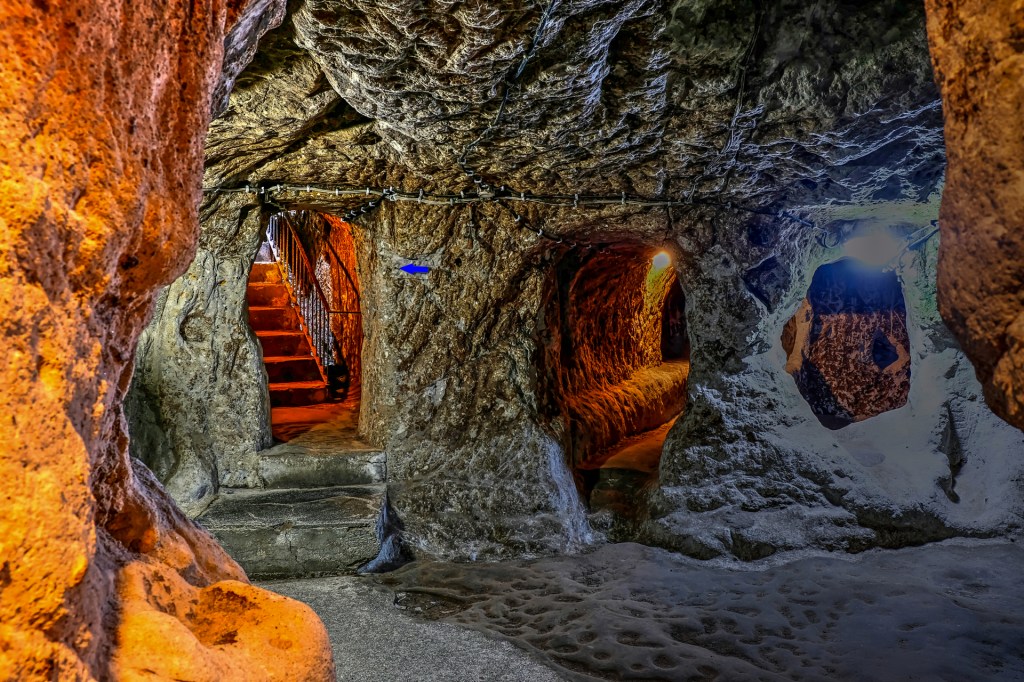

Elengubu is the largest of these underground complexes but apparently there are many in Cappadocia, Turkey! Sections could be closed off with large rolling stone doors. Elengubu contains wine and oil presses, stables, cellars, storage rooms. On the second floor, there’s a spacious room with a barrel-vaulted ceiling. The lowest level is five levels underground at 280 feet deep. I want to explore them! Visitors can access about half of the network, since 2016. I want to explore them!
Join our discussion at Marie Judson’s Readers on Facebook!
Click here to sign up for Marie Judson’s Writer’s Log (newsletter)!


 Marie Judson
I forgot to investigate how they got air down through the underground levels. “The ancient underground city of Elengubu (known today as Derinkuyu) had a complex ventilation system using a network of ventilation shafts and horizontal tunnels to ensure air circulation through its various levels. These shafts, some up to 52 vertical and over 15,000 small ones, reached down into the deeper levels, providing fresh air and even allowing for communication.” Wow! So cool. So innovative, so long ago. I wonder how they kept the vents safe where they accessed the surface ground.
LikeLike